
Introduction
When discussing diagnostic tests, two terms often confuse beginners and even experienced lab professionals : i.e. sensitivity and specificity. Whether you work in a clinical laboratory, or you are a medical students or simply want to understand test accuracy, it’s crucial to define sensitivity and specificity clearly fisrt.
Table of Contents
"Define Sensitivity and Specificity” What Does It Really Mean ? Let's explore :

Let’s start with sensitivity and specificity meaning in simple language:
what is Sensitivity ?
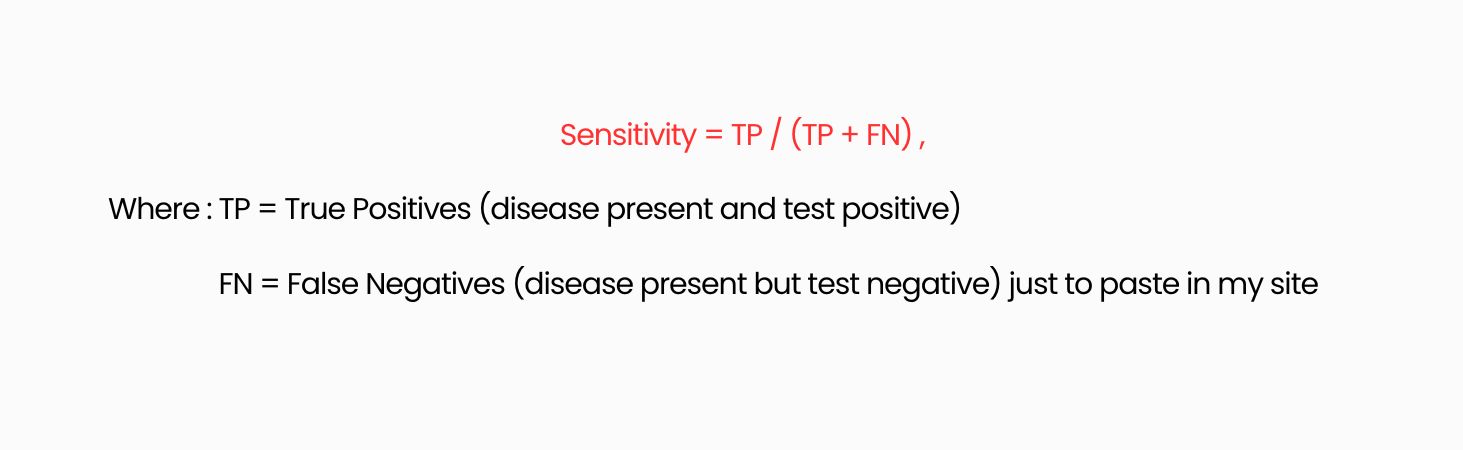
Sensitivity = the ability of a test to correctly detect true positive cases.
In other words, if someone truly has the disease, a test with high sensitivity will successfully detect it.
Everyday Example
Imagine a COVID-19 rapid antigen test.
If 100 infected people take the test and it correctly identifies 95 of them, the test’s sensitivity is 95%.
A test with high sensitivity is excellent for screening, because it reduces the chance of false negatives.
What Is Specificity ?
Now let’s understand specificity meaning:
Specificity = the ability of a test to correctly detect true negative cases.
That means if someone does not have the disease, a highly specific test will correctly show a negative result.
Example : If 100 healthy people take an influenza test and 98 get the correct “negative” result, the specificity is 98%. Tests with high specificity are ideal for confirmation, because they minimize false positives.

Together, these formulas are sometimes called the specificity and sensitivity formula—and both are included in the free calculator below.
Free Sensitivity & Specificity Calculator
To help beginners avoid confusion and manual mistakes, here is your free sensitivity and specificity calculator:
👉 How to Use It
- Enter true positive (TP) value
- Enter false negative (FN) value
- Enter true negative (TN) value
- Enter false positive (FP) value
- Click “Calculate”
The tool will instantly compute values using the sensitivity formula and formula for specificity, saving time and making the learning process easier.
How To Calculate Specificity And Sensitivity
Use our calculator to determine diagnostic test accuracy metrics including sensitivity, specificity, PPV, and NPV
Test Results For Disease-Positive (Sensitivity)
Test Results For Disease-Negative (Specificity)
Diagnostic Test Results
Understanding The Metrics
Sensitivity: The ability of a test to correctly identify those with the disease (true positive rate).
Specificity: The ability of a test to correctly identify those without the disease (true negative rate).
Positive Predictive Value (PPV): The probability that subjects with a positive test truly have the disease.
Negative Predictive Value (NPV): The probability that subjects with a negative test truly don't have the disease.
Sensitivity vs. Specificity: Key Differences
Although these terms are often taught together, they serve different roles. You can make this clearer by using a simple sensitivity and specificity table:
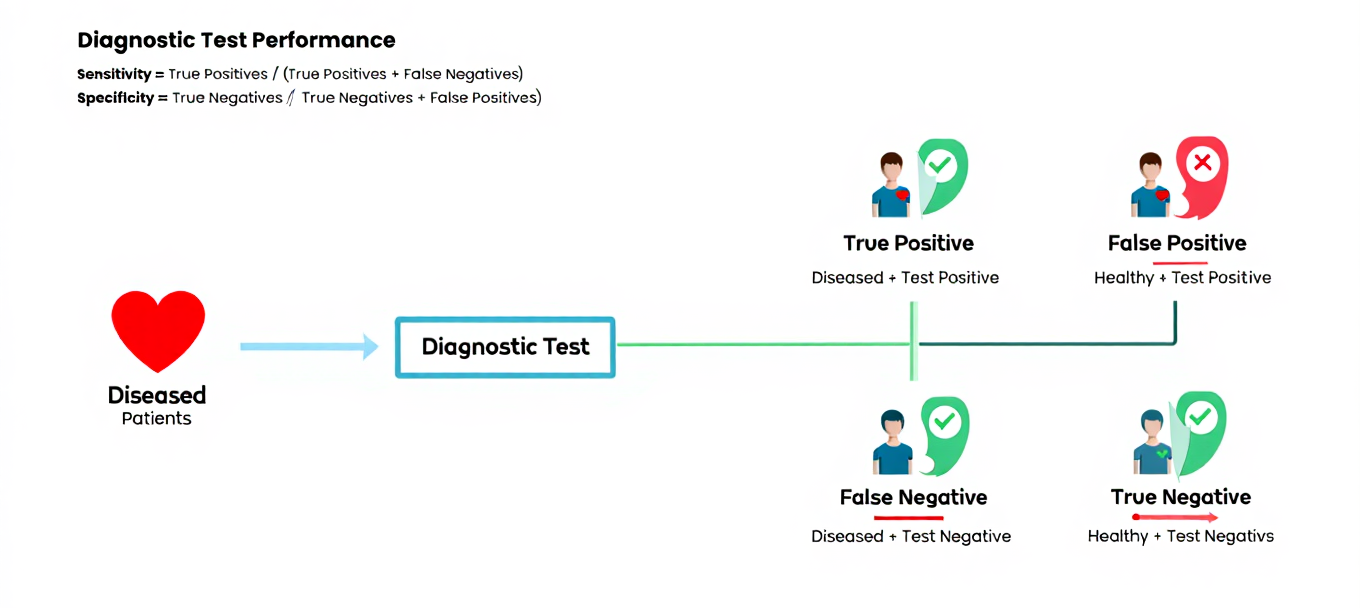
Quick Summary
- To ensure 100% sensitivity, the test shouldn’t miss true cases.
- To ensure 100% specificity, the test shouldn’t wrongly detect disease.
Understanding these differences makes it easier to truly define sensitivity and specificity in real-world diagnostic work.
Common Mistakes Beginners Make
Many users misinterpret sensitivity and specificity when they don’t fully understand the concepts. Here are the most frequent errors:
- Mixing Up False Positives and False Negatives
This is the #1 confusion. Your calculator will help users visualize these values correctly.
- Assuming a Test with High Sensitivity Is Always Better
High sensitivity is good for screening but not always for confirming.
- Ignoring Specificity When Evaluating Positive Results
A test may detect many positives—but how many of them are accurate?
- Believing Sensitivity and Specificity Change with Prevalence
They don’t. Predictive values do, but sensitivity and specificity remain constant.
Being aware of these mistakes will help readers properly define sensitivity and specificity in any context.
Sensitivity & Specificity in Real Lab Practice
In microbiology and clinical testing, understanding sensitivity and specificity is essential for:
1. Test Validation
Manufacturers and labs evaluate test performance before releasing or adopting a test.
2. Diagnostic Decision Making
Doctors rely on sensitivity and specificity to interpret results.
3. Comparison Between Test Kits
Different kits may show different accuracy levels in the field.
4. Quality Control
QC processes often refer to sensitivity, specificity, and accuracy together.
Common lab areas where these metrics are used include:
- Rapid antigen tests
- PCR assays
- Serology tests
- Culture reports
- Antimicrobial panels
So, when you define sensitivity and specificity in real practice, you are actually explaining how trustworthy a lab result is.
Frequently Asked Questions (FAQs)
What is a good sensitivity?
Above 90% is ideal, but it depends on the disease and purpose.
What is a good specificity?
90%+ is good, especially for confirmatory tests.
Is sensitivity more important than specificity?
It depends on whether the test is for screening or confirmation.
how to calculate sensitivity ?
Sensitivity is the ability of a diagnostic test to correctly identify individuals who actually have the disease. A highly sensitive test has very few false negatives.
what is specificity ?
Specificity is the ability of a diagnostic test to correctly identify individuals who do NOT have the disease. A highly specific test produces very few false positives.
what is sensitivity ?
Sensitivity is the ability of a test to correctly identify people who have a disease.
In simple terms, it measures how good the test is at detecting true positive cases.
Note : You can also try our Online Calculator tool for quick results.