
Introduction
The germ tube test for Candida albicans is a simple and quick laboratory test used to identify Candida albicans based on its ability to form germ tubes—short, filamentous projections—when incubated in serum at 37°C for 2-3 hours.
Table of Contents
Principle of the Germ Tube Test
Candida albicans produces germ tubes (early hyphal extensions) under favorable conditions, such as:
Temperature: 37°C (human body temperature)
Nutrient-rich environment: Serum (usually fetal bovine serum or human serum)
Other Candida species (e.g., Candida tropicalis, Candida glabrata) do not form germ tubes under these conditions, making this test highly specific for C. albicans.
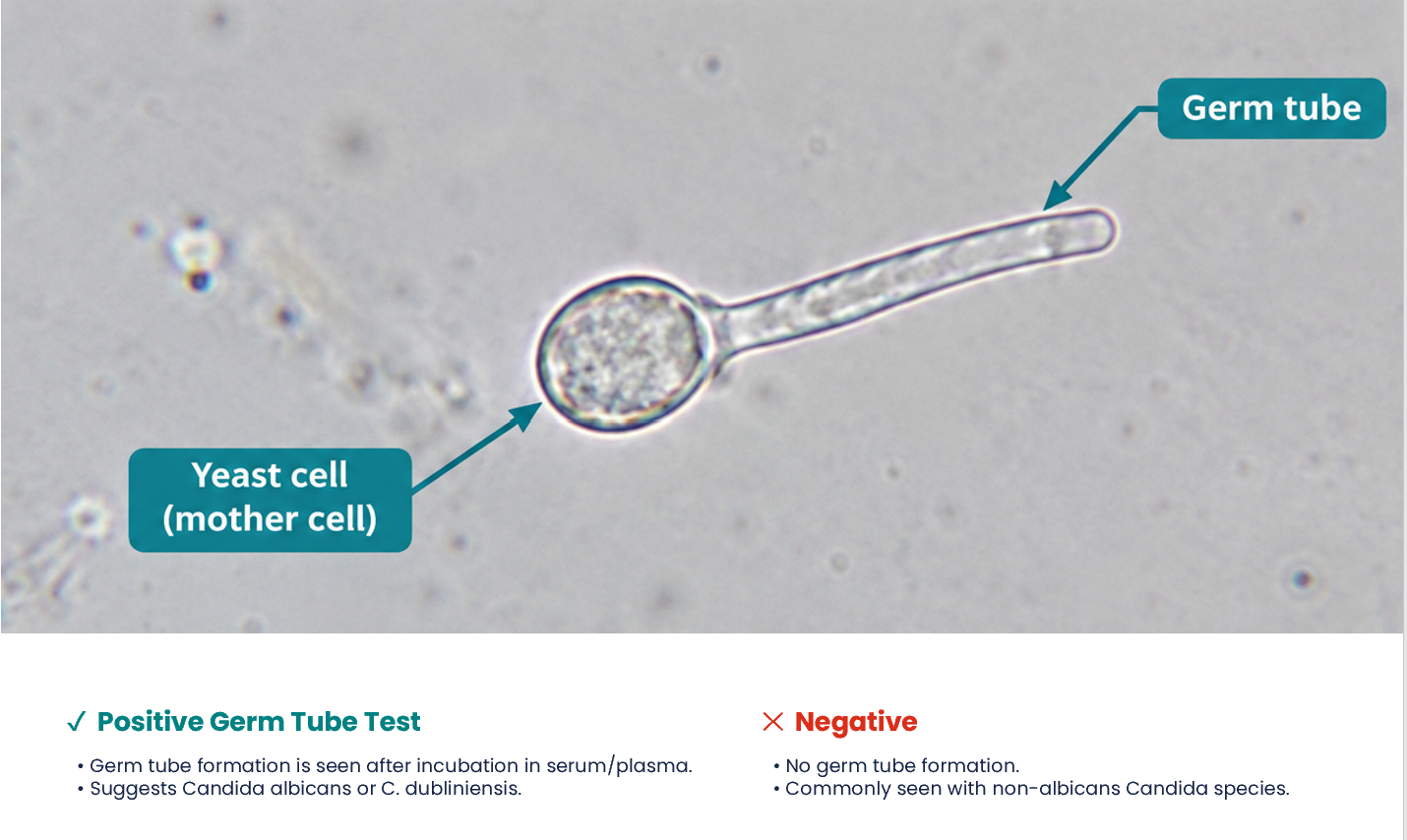
A germ tube is a short, slender, tube-like outgrowth that sprouts from a yeast cell when it is placed in a suitable protein-rich medium and warmed. It is typically about half the width of the parent cell and several times its length. The key feature is that it has no constriction at the point where it joins the yeast cell, so the cell and its tube look like one continuous structure, like a tiny comma or a small club.
This is what separates a true germ tube from a pseudohypha. A pseudohypha is a chain of elongated buds, and it shows a pinched constriction where it attaches to the mother cell.
Reagents
Human serum A small volume to be used as a working solution may be stored at 2 to 8⁰C. Stock solution can be dispensed into small tubes and stored at -20⁰C.
Materials Required
Fresh yeast colony (from Sabouraud dextrose agar or CHROMagar)
Sterile serum (fetal bovine serum or human serum)
Incubator (37°C)
Microscope slides and coverslips
Light microscope
Step-by-Step Method
Prepare the Serum Mixture:
Place 0.5 mL of sterile serum in a test tube.
Emulsify a small portion of a pure yeast colony in the serum to create a slightly turbid suspension.
Incubation:
Incubate the mixture at 37°C for 2-3 hours.
Microscopic Examination:
After incubation, place a drop of the mixture on a glass slide and cover it with a coverslip.
Examine under a light microscope (40X magnification) for the presence of germ tubes.
Interpretation
| Observation | Examples |
|---|---|
| Positive Results : Germ tubes present (tube-like extensions without constrictions at the origin) | Candida albicans and Candida dubliniensis |
Negative Results : No hyphal extension from yeast cells OR Short hyphal extension with constriction at the origin. | C. tropicalis , C. glabrata and other non-albicans Candida species |
Quality control
Every new batch of serum should be checked with controls:
- Positive control: a known albicans strain
- Negative control: a known non-albicans strain such as tropicalis or C. glabrata
Sources of error
- Over-incubation. Beyond 3 hours, some non-albicans species (notably tropicalis) may form pseudohyphae that look like germ tubes, producing a false positive.
- Heavy inoculum. Too many cells can suppress germ tube formation and cause a false negative.
- Poor serum quality. Old or contaminated serum may not support germination.
- Incorrect temperature. Incubation well below 37 °C reduces germ tube production.
- Closely related species. dubliniensis also forms germ tubes, so a positive GTT alone cannot separate it from C. albicans.
Precaution
C. tropicalis may form pseudohyphae which may be falsely interpreted as germ tubes.
Direct germ tube test from positive blood culture bottles
Traditionally, the GTT is done on colonies, which means waiting 24–72 hours for growth. A 2008 study by Sheppard and colleagues in the Journal of Clinical Microbiology examined whether the test could be done directly from a blood culture bottle that had flagged positive and shown yeast on Gram stain.
In their approach, a very small volume (10–20 µL) of the bottle contents was mixed with serum and incubated at 37 °C for 3 hours, which removes the need to wait for subculture growth. Key findings:
- In clinical samples, the direct test showed a sensitivity of 87.1% and a specificity of 100% compared with the colony-based GTT.
- No non-albicans yeast gave a false-positive result.
- A few albicans isolates were missed in the direct test but were positive when tested from colonies. The authors noted that some of these were slower-growing strains present in lower numbers in the bottle.
- Including laboratory-seeded bottles, overall sensitivity was 92.2% and specificity 100%.
Frequently Asked Questions
Can other Candida species produce germ tubes?
Rarely, Candida dubliniensis may also form germ tubes, leading to false positives. However, this species is less common than C. albicans.
What is the difference between germ tubes and pseudohyphae?
Germ tubes: Filamentous extensions without constrictions at their origin.
Pseudohyphae: Chain-like structures with constrictions between cells (seen in other Candida species).